Psychological safety has become one of the most talked-about concepts in organisational development. And with good reason — Google’s Project Aristotle research, which identified it as the single most important factor in high-performing teams, has been widely discussed and widely cited.
What gets discussed less is how to actually build it into Asian workplace contexts — where the dynamics of hierarchy, face-saving, and indirect communication create specific challenges that a lot of the mainstream material doesn’t address.
This is a practical piece. It’s written for HR leaders and managers who understand the concept and want to know how to apply it in Hong Kong and across Asia’s diverse team environments.
What Psychological Safety Actually Means (and What It Doesn’t)
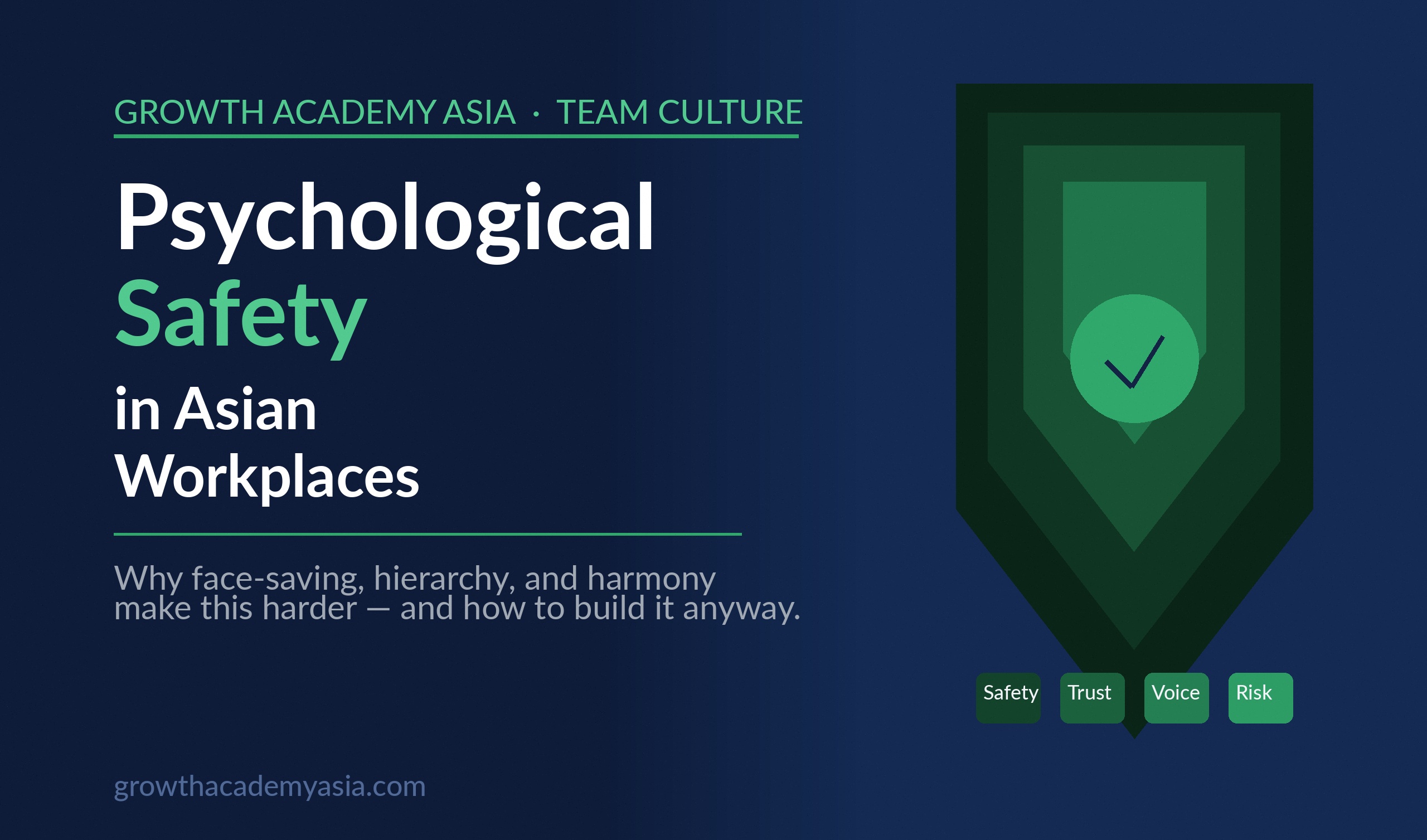
Psychological safety is the belief that you won’t be punished or humiliated for speaking up — for sharing ideas, raising concerns, asking questions, or admitting mistakes. It’s a team-level phenomenon, not an individual one. It’s not about whether each person feels comfortable in general; it’s about whether the team collectively has built a climate where that kind of openness is normal and safe.
It does not mean teams where everyone agrees, where there’s no accountability, or where anything goes. Those confusions are common and they lead to poorly designed programmes. A psychologically safe team still has standards, still challenges ideas, and still holds people accountable. The difference is that those conversations happen without the fear of retaliation, dismissal, or embarrassment.
Why It’s Harder to Build in Asian Contexts — and Why That Doesn’t Mean It Can’t Be Done
Several dynamics in many Asian workplace cultures work against this definition of psychological safety. They’re worth naming clearly.
Face and reputation. In cultures where professional reputation and face carry significant weight, the risk of being seen as wrong, ignorant, or a troublemaker is higher. People may self-censor to protect their standing, even when they have valuable information or perspectives to contribute.
Hierarchy and power distance. In high power-distance cultures, there’s a strong expectation that those with authority make the decisions, and those without it defer. Speaking up against a manager’s view — particularly in a group setting — may feel inappropriate regardless of whether it’s genuinely risky.
Group harmony. Many Asian cultures place high value on maintaining harmony within the group. Raising a concern that might create conflict, even a well-intentioned one, can feel like a violation of a social norm.
None of these dynamics make psychological safety impossible. But they do mean that the path to building it looks different. You can’t just announce an open-door policy or put “speak up” on a poster and expect much to change.
What Actually Works
Leaders go first. The most powerful thing a leader can do to build psychological safety is to model the behaviours they’re asking for. That means admitting uncertainty, acknowledging when they got something wrong, asking for input genuinely (and responding to it constructively), and thanking people who raise problems rather than punishing them.
This is particularly important in high power-distance contexts. When the most senior person in the room says “I don’t know — what do you think?” or “I made a mistake on that call last week, here’s what I’d do differently,” they give everyone else in the room permission to be human too.
Make it normal to be wrong in low-stakes situations. One of the most effective approaches I’ve seen is building in regular low-stakes opportunities to share incomplete thinking, ask basic questions, or admit confusion. Team retrospectives, learning check-ins, and structured reflection sessions — run well — create a habit of openness that transfers to higher-stakes moments.
Design for smaller groups and private feedback channels. Many people who won’t speak up in a group of twelve will speak honestly in a conversation with two or three peers, or in a structured one-on-one. If you want psychological safety across the whole team, you need to create the conditions for it at multiple levels — not just in full-team settings.
Acknowledge the cultural context explicitly. One of the most powerful moves a leader or facilitator can make is to name the tension directly. Something like: “I know it can feel risky to challenge an idea in this kind of meeting. I want us to build something different here, and that starts with me being clear that I genuinely want to hear when something isn’t working.” This doesn’t solve everything, but naming the dynamic gives the team permission to act differently.
Follow through on the signals people send. Psychological safety gets built or broken in small moments. When someone raises a concern and the response is dismissive — even mildly — it sends a message that’s louder than any open-door policy. When someone shares a mistake and it’s treated with curiosity rather than blame, that memory spreads through the team. Leaders who want to build a safe climate need to be especially careful about how they respond to the first brave acts of speaking up.
When to Bring in a Training Partner
Building psychological safety isn’t a one-session fix. It’s an ongoing team practice that leadership training can accelerate and sustain.
A good training intervention for psychological safety typically combines a shared framework (so the team has a common language), experiential exercises (so the behaviours get practised, not just discussed), and manager coaching (so leaders develop the specific habits that maintain the climate between sessions).
When selecting a vendor for this kind of work, look for facilitators who have genuine experience with the cultural dynamics in your teams — who won’t just run a generic workshop that assumes Western communication norms. The best facilitators in this space are skilled at creating the kind of safe space in the room that models what they’re teaching.
At Growth Academy Asia, we can match you with facilitators who have specific experience building psychological safety in Asian teams. Start the matching process here.
Stuart Harris is co-founder of Growth Academy Asia. He has spent 22 years working with HR teams and training providers across Hong Kong and Asia.