By executive leadership coaches Jass Malaney and Jose M. Romero.
Many organisations do not have a strategy problem. They have a leadership consistency problem. In a business environment defined by rapid change and complexity, what decides whether transformation succeeds is rarely the strategy on paper. It is whether leaders can build trust, create alignment, and sustain performance while their people adapt faster than ever.
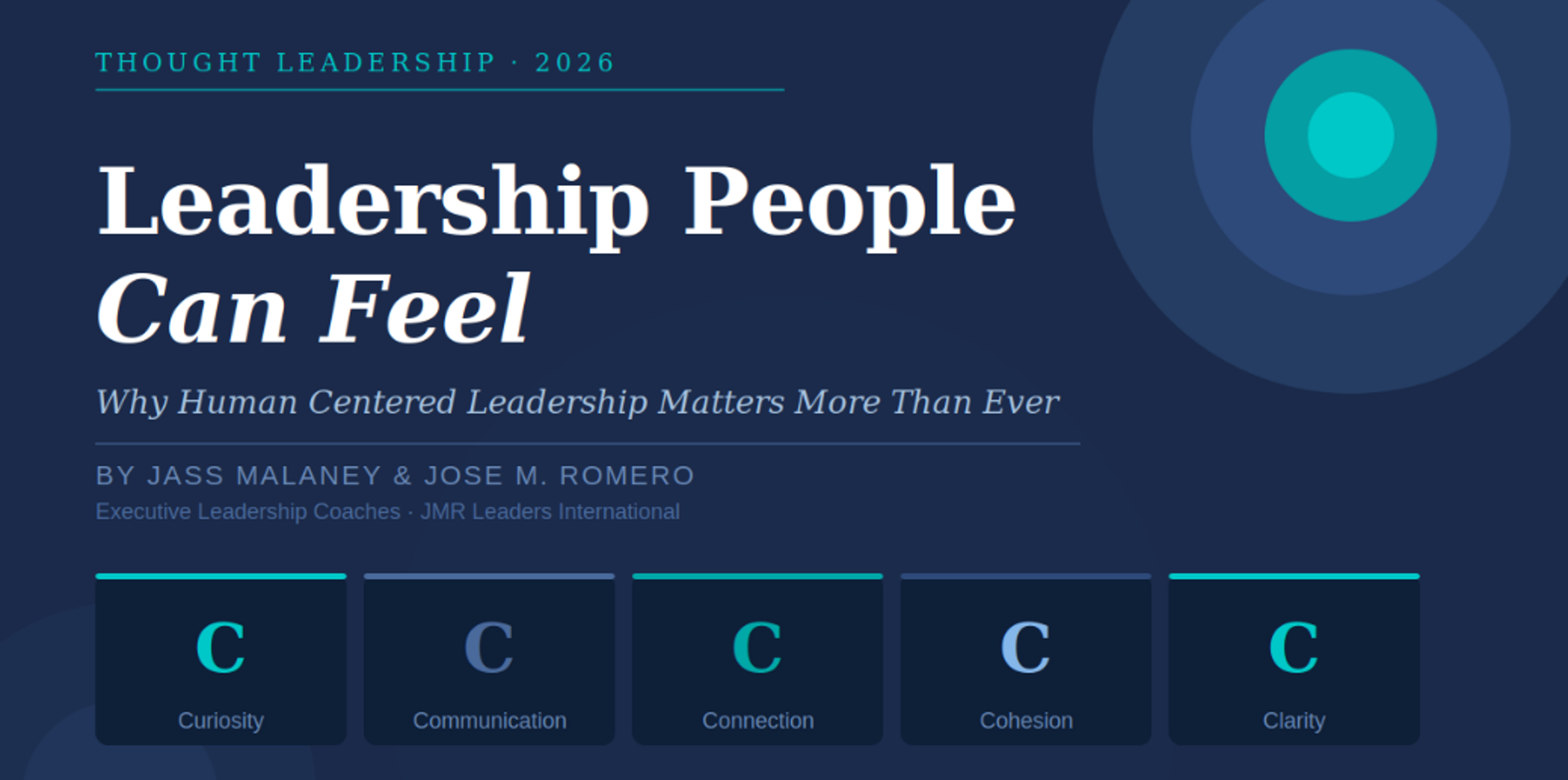
Despite heavy investment in transformation, many companies face the same internal challenges: disengagement, leadership fatigue, cultural fragmentation, and declining trust across teams. What they are experiencing is not resistance to change. It is exhaustion from continuous change without enough leadership: curiosity, communication, connection, cohesion and clarity (our 5 C’s).
For years leadership was measured by operational results, technical expertise, and execution. Those still matter, but they are no longer enough on their own. The most effective leaders today combine strategic thinking with emotional intelligence to build sustainable, meaningful relationships. They steady a team during uncertainty, align people through complexity, and create cultures where psychological safety, accountability and trust coexist. People do not simply follow strategy. They follow leaders they trust.
The hidden cost of leadership misalignment
Across industries, the same patterns emerge:
- Leadership teams struggle to align despite clear business goals.
- Collaboration breaks down across functions and departments.
- Managers are expected to deliver results while leading people through uncertainty.
- Employees want more meaning, growth, and connection at work.
- Leadership programmes create temporary motivation but little lasting change.
Most companies try to solve this with one-off workshops or engagement initiatives. Useful in the short term, but they feel transactional and rarely create real transformation. The reason is not a lack of effort. It is that most leadership development happens outside the reality of the business. Leaders return inspired for a few days, then re-enter the same systems, pressures and cultural habits as before.
Culture does not change through isolated events. It changes through repeated leadership behaviour, communication, accountability, and shared experiences over time, connected to the company’s mission, values and goals. Every leadership team creates a culture, intentionally or not. The real question is whether it reinforces clarity, ownership and trust, or quietly creates friction, silos and disengagement.
Why human-centred leadership drives performance
Human-centred leadership is often misunderstood as soft, or only about employee wellbeing. In reality it is directly connected to performance. High-performing cultures are rarely built through pressure alone. They are built where people understand expectations, feel safe to contribute and take risks, and trust the people leading them.
Organisations with effective leadership cultures consistently outperform those where leadership behaviour is fragmented. Engagement improves, collaboration speeds up, decision-making strengthens, and belonging grows. This is why many organisations are moving away from isolated training toward longer leadership journeys that combine coaching, team alignment, experiential learning and cultural integration. When leadership development becomes part of how leaders communicate, decide and lead every day:
- Teams align around priorities and accountability.
- Collaboration improves across departments.
- Leaders communicate with more clarity and confidence.
- Decision-making stays grounded during uncertainty.
- Performance becomes more sustainable over time.
The human advantage in an automated world
As AI dominates business strategy, many organisations are asking the same question: what remains uniquely human? Technology can accelerate analysis and automate processes, but organisations still depend on people to inspire trust, navigate uncertainty, resolve conflict and create culture. That is the human advantage, and it is becoming more valuable. The future of leadership belongs to leaders who can balance performance with humanity, drive results while building trust, and create accountability without losing authentic connection.
People join organisations for the opportunity. They stay, contribute and go beyond because of leadership that inspires them and helps them grow. Leadership people can feel is one of the strongest competitive advantages any organisation can build.
Frequently asked questions
What is human-centred leadership?
A leadership approach that combines strategic thinking with emotional intelligence, building trust, psychological safety and accountability so teams perform sustainably, not just under pressure.
Why do leadership training programmes often fail to stick?
Because they happen as one-off events outside the day-to-day business. Lasting change comes from repeated leadership behaviour and coaching embedded into the culture over time.
How do you build leadership consistency across a team?
Connect development to the company’s mission and goals, combine coaching with team alignment and experiential learning, and reinforce the behaviours daily rather than in isolated workshops.
If you are looking for leadership coaching or development partners for your team in Hong Kong or across Asia, Growth Academy Asia can match you with providers we have interviewed and vetted. We don’t deliver training ourselves.
About the authors
Jose M. Romero is a certified Global Chief Master Coach partnering with C-suite leaders and executive teams worldwide (josemiguelromero.com).
Jass Malaney is a certified Professional and Master Coach who works with high-potential leaders and C-suite executives across geographies and cultures (jassmalaney.com).