I’ve had a version of the same conversation dozens of times over the past few years. An HR Director tells me they spent three weeks on a vendor sourcing process — writing the brief, emailing providers, chasing responses, reviewing proposals — and still walked away unsure they’d found the right fit. Sometimes they had. Often they hadn’t.
That process hasn’t been broken because HR teams are bad at sourcing. It’s been broken because the right tools haven’t existed in this market. Until recently.
I built the AI matching component of Growth Academy Asia specifically because I got tired of watching good HR professionals spend their energy on the logistics of finding vendors, when the real work — understanding your team’s needs, asking the right questions, making an informed decision — deserved more of their attention.
Here’s what I’ve learned about how it works, what it changes, and what it doesn’t.
What AI Matching in Training Sourcing Actually Means
There’s a lot of loose talk about AI in corporate training right now. I want to be precise about this, because the noise doesn’t help anyone.
AI matching in vendor sourcing has nothing to do with replacing training with chatbots or generated content. It’s about doing the first-pass matching work that a well-connected human expert would otherwise have to do manually — and doing it in minutes rather than days.
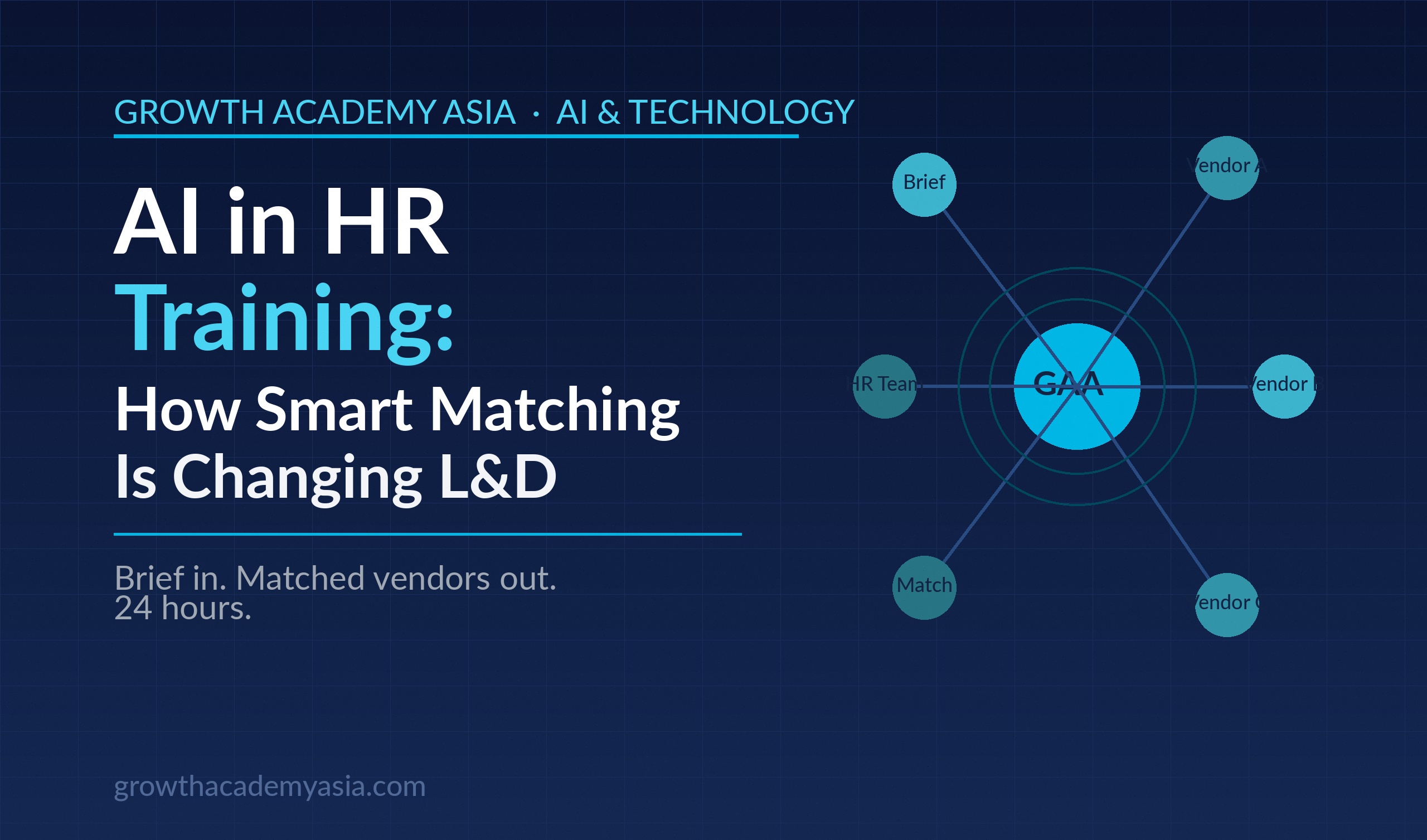
In practical terms: you describe your training need — your team’s context, the problem you’re trying to solve, your audience, your constraints — and the AI interprets that brief against a database of vetted providers to produce a shortlist. Not a generic shortlist. One shaped by the specific details of what you actually told us.
The phrase I use internally is: the speed is AI, the trust is human. The algorithm moves fast. But what makes the matches reliable is what sits underneath it — over two decades of knowing this vendor landscape, and a database built entirely from providers we’ve personally interviewed, not scraped from the web.
Why This Matters More in Asia Than Elsewhere
I’ve worked in training markets in Europe and the US as well as across Asia. Hong Kong and the broader Asia market have a specific challenge that makes AI-assisted discovery more valuable here than almost anywhere else.
The best providers in this market are largely invisible to anyone who doesn’t already know them. They don’t spend on Google ads. They don’t have high-traffic websites. They run on referral networks that take years to build access to. If you’re new to a role, or sourcing outside your usual area of expertise, those providers simply don’t show up in your search results.
What search surfaces is the vendors who’ve invested in SEO — which is a reasonable proxy for a marketing budget, but a limited proxy for training quality. I see the gap between those two things constantly. Some of the best facilitators I’ve worked with over 20 years would be invisible to someone who searched Google this morning.
AI matching that draws on a curated, interviewed database rather than a web crawl changes that dynamic. It gives HR teams access to providers based on genuine fit, not marketing spend.
What Doesn’t Change
I want to be honest about this, because I’ve seen the AI-in-HR conversation go badly in both directions — dismissing it entirely as hype, or treating it as a full substitute for human judgment. Neither is right.
The questions that actually matter in vendor selection haven’t changed and won’t change. Does this facilitator genuinely understand the context my team is operating in? Have they worked with this audience level, in this geography, with these dynamics? Will their approach land with our culture? What happens after the workshop ends?
AI can get the right candidates in front of you faster. It cannot answer those questions for you. The final stages of a good vendor process — the conversations, the probing, the reading of whether there’s genuine fit — still require you. That’s not a limitation of the technology. It’s just where human judgment belongs in this process, and I’d be doing you a disservice to suggest otherwise.
How Growth Academy Asia Uses AI in the Matching Process
When an HR team briefs us — by WhatsApp, through our platform, or on a call — our AI interprets that brief against our vendor network. It assesses fit across training topics and methodology, geographic expertise, audience level, programme format, cultural context, and a range of other criteria we’ve found actually matter in practice.
The output is a shortlist of two to three matched vendors, each with a tailored draft proposal. Not a template that gets recycled across briefs. Something shaped by what you actually told us about your situation.
What makes the matching reliable is what sits underneath it. Every vendor on our platform has been interviewed by us before they’re listed. We know their strengths, their style, their best use cases, and specifically where they’re not the right fit. That knowledge is what the AI works against. You get the speed without sacrificing the quality of the match.
Most requests are turned around within 24 hours. If you’ve been through a three-week RFP process before, that gap feels significant.
What This Means for You
Vendor sourcing doesn’t have to be the slow, overhead-heavy part of training procurement. The logistics — who to talk to, who has the right experience, who’s worth shortlisting — can be compressed dramatically without sacrificing quality.
What that frees up is time for the part of the process that actually requires your expertise. Understanding your team’s real need. Asking the right questions of the vendors you meet. Making a decision you’re confident in.
For HR Directors managing multiple priorities, that shift matters. For L&D managers running multiple programmes a year, it compounds over time.
If you’d like to see how the matching works in practice, send us a brief here and we’ll come back to you within 24 hours. Or read more about the GAA approach if you want to understand the model first.
Stuart Harris is co-founder of Growth Academy Asia. He has spent 22 years working with HR teams and training providers across Hong Kong and Asia.